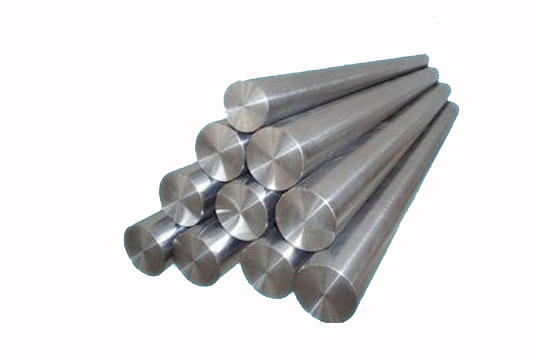
Titanium Rod
Titanium is highly resistant to chloride-containing media, practically all salt solutions, seawater, a range of acids, organic and inorganic chemicals, and gases. The high environmental resistance is primarily based on a very thin, tenacious, and highly protective surface oxide film. The oxide film provides high resistance to erosion in high-velocity process streams. It is non-magnetic and characterized by a high melting point, high strength-to-weight ratio, and a low modulus of elasticity.
Titanium Rod Specifications
| Size | Dia. : 3 mm – 600 mm |
|---|---|
| Material | Gr.1, Gr.2, Gr.3, Gr.4, Gr.5, Gr.7, Gr.9, Gr.23, etc. |
| Standard | ASTM B348, ASTM F67, AMS 4928, ASTM F136,etc. |
| Surface | Black, pickling, sand-blasting, polished |
| Shape | Square bar, round bar, hexagonal bar, etc. |
| Condition | Cold rolled(Y), hot rolled(R), annealed (M), quenching (C) |
Titanium Rod Applications
Titanium Rod has many applications including chemical processing, medical instruments, the aerospace industry, navigation, smelting, chemical plants, machinery, equipment, electroplating equipment, precision instruments standard parts, and titanium wind leaf.
Chemical Requirements of Titanium Rod (Nominal %)
| N | C | H | Fe | O | Al | V | Pa | Mo | Ni | Ti | |
|---|---|---|---|---|---|---|---|---|---|---|---|
| Gr. 1 | 0.03 | 0.08 | 0.015 | 0.2 | 0.18 | / | / | / | / | / | Remaining |
| Gr. 2 | 0.03 | 0.08 | 0.015 | 0.3 | 0.25 | / | / | / | / | / | Remaining |
| Gr. 3 | 0.05 | 0.08 | 0.015 | 0.3 | 0.35 | / | / | / | / | / | Remaining |
| Gr. 4 | 0.05 | 0.08 | 0.015 | 0.5 | 0.4 | / | / | / | / | / | Remaining |
| Gr. 5 | 0.05 | 0.08 | 0.015 | 0.4 | 0.2 | 5.5~6.75 | 3.5~4.5 | / | / | / | Remaining |
| Gr. 7 | 0.03 | 0.08 | 0.015 | 0.3 | 0.25 | / | / | 0.12~0.25 | / | / | Remaining |
| Gr. 9 | 0.03 | 0.08 | 0.015 | 0.25 | 0.15 | 2.5~3.5 | 2.0~3.0 | / | / | / | Remaining |
| Gr.12 | 0.03 | 0.08 | 0.015 | 0.3 | 0.25 | / | / | / | 0.2~0.4 | 0.6~0.9 | Remaining |
Mechanical Requirements of Titanium Rod
| Grade | Tensil Strength (min) | Yeild Strength (min) | Elongation(%) | ||
|---|---|---|---|---|---|
| ksi | MPa | ksi | MPa | ||
| 1 | 35 | 240 | 20 | 138 | 24 |
| 2 | 50 | 345 | 40 | 275 | 20 |
| 3 | 65 | 450 | 55 | 380 | 18 |
| 4 | 80 | 550 | 70 | 483 | 15 |
| 5 | 130 | 895 | 120 | 828 | 10 |
| 7 | 50 | 345 | 40 | 275 | 20 |
| 9 | 90 | 620 | 70 | 438 | 15 |
| 12 | 70 | 438 | 50 | 345 | 18 |
Titanium Rod Features
Titanium Rod Testing
Titanium rod is produced, and certified to Medical (ASTM F67, ASTM F136, ISO5832-2, ISO5832-3), Aerospace (AMS 4928, AMS 2631b), Industrial (ASTM B348) standards. Stock production is aligned to ASTM, AMS, and ISO standards with other standards available.